
Bouquet Size Guide: How to Pick the Right Stem Count
Bouquet Size Guide: How to Pick the Right Stem Count
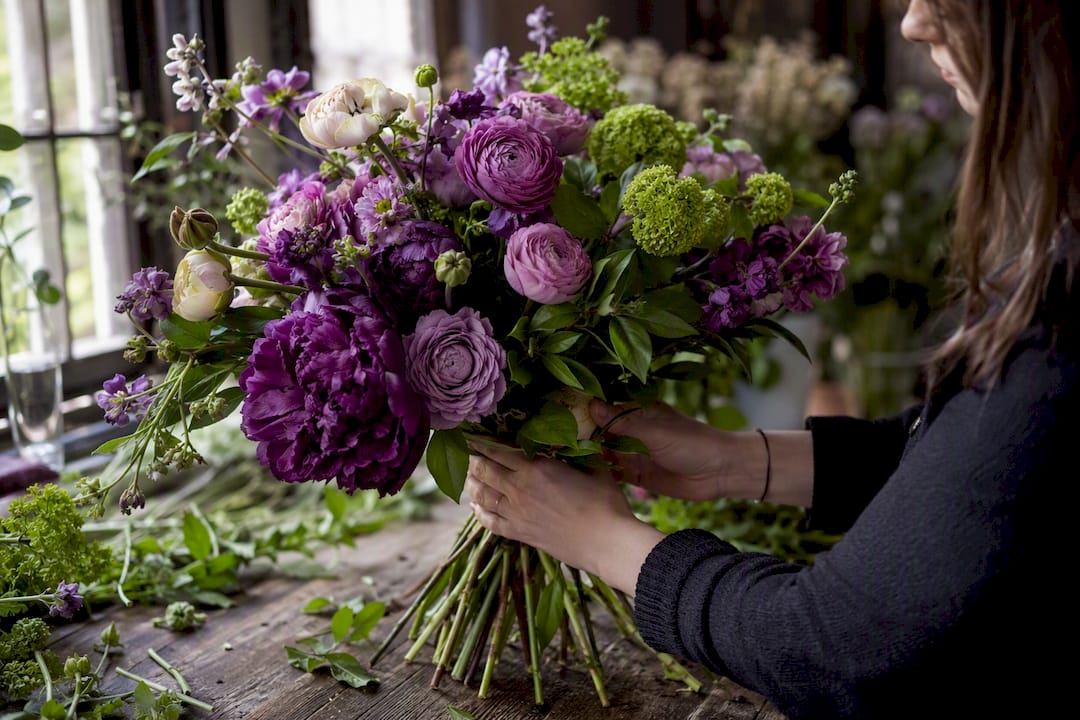
Choose small bouquets for personal gifts or tabletop posies, medium-sized ones for most bouquet gifts and bridesmaids, large bouquets for dramatic bridal or presentation pieces, and very large bouquets for statement or ceremonial pieces. That is the entire decision in one sentence. Everything below just helps you apply it to your specific situation.
Here is the quick version before you scroll further:
- Small (10–20 stems): birthday gifts, bedside vases, junior bridesmaid posies.
- Medium (20–35 stems): standard bridal bouquets, guest and thank-you arrangements.
- Large (35–50 stems): bridal statement bouquets, ceremony presentation pieces.
- Luxury (50+ stems): altar displays, welcome signage, oversized centerpieces.
Stem counts are never fixed math. A dozen peonies fills a bouquet that would take three dozen carnations to match, so treat every number here as a starting point tied to bloom size, not a rule carved in stone.
Key Takeaways
Bouquet size comes down to matching stem count and focal bloom size to how the arrangement will be held, worn, or displayed, not to a fixed number alone.
| Point | Details |
|---|---|
| Match size to occasion | Small (10–20 stems) for gifts, medium (20–35) for standard bridal, large (35–50) for statement pieces. |
| Bloom size changes the math | Large focal blooms like peonies need fewer stems than small filler blooms to reach the same volume. |
| Use the 3-5-8 ratio | Build with 3 focal, 5 textural, 8 filler stems as a base, then scale the ratio up or down. |
| Height follows the vase | Keep the tallest stem about 1.5 to 1.6 times the vase height to avoid a top-heavy look. |
| Malikflowers sizes to fit | Custom bridal consultations and same-day Metro Vancouver delivery back every order with a satisfaction guarantee. |
Table of Contents
- What Is the Standard Bouquet Size Chart?
- How Do You Choose the Right Bouquet Size for Your Situation?
- Why Do Florists Use the 3-5-8 Rule?
- How Do Focal, Textural, and Filler Stems Change the Look?
- What Most Sizing Advice Gets Wrong
- Sources
- FAQ
What Is the Standard Bouquet Size Chart?
Florists generally sort bouquets into four working categories, and the differences between them show up in your hand, not just on a receipt. A small bouquet sits comfortably in one palm. A large one needs both arms and a determined grip.
| Size | Stem count | Approx. diameter | Best for |
|---|---|---|---|
| Small | 10–20 stems | 6–8 in | Personal gifts, bedside vases, small bridesmaid posies |
| Medium | 20–35 stems | 10–14 in | Standard bridal bouquets, guest gifts, larger arrangements |
| Large | 35–50 stems | 13–16 in | Dramatic bridal bouquets, presentation pieces |
| Luxury/Statement | 50+ stems | 13–15 in | Ceremony focal pieces, signage, major event displays |
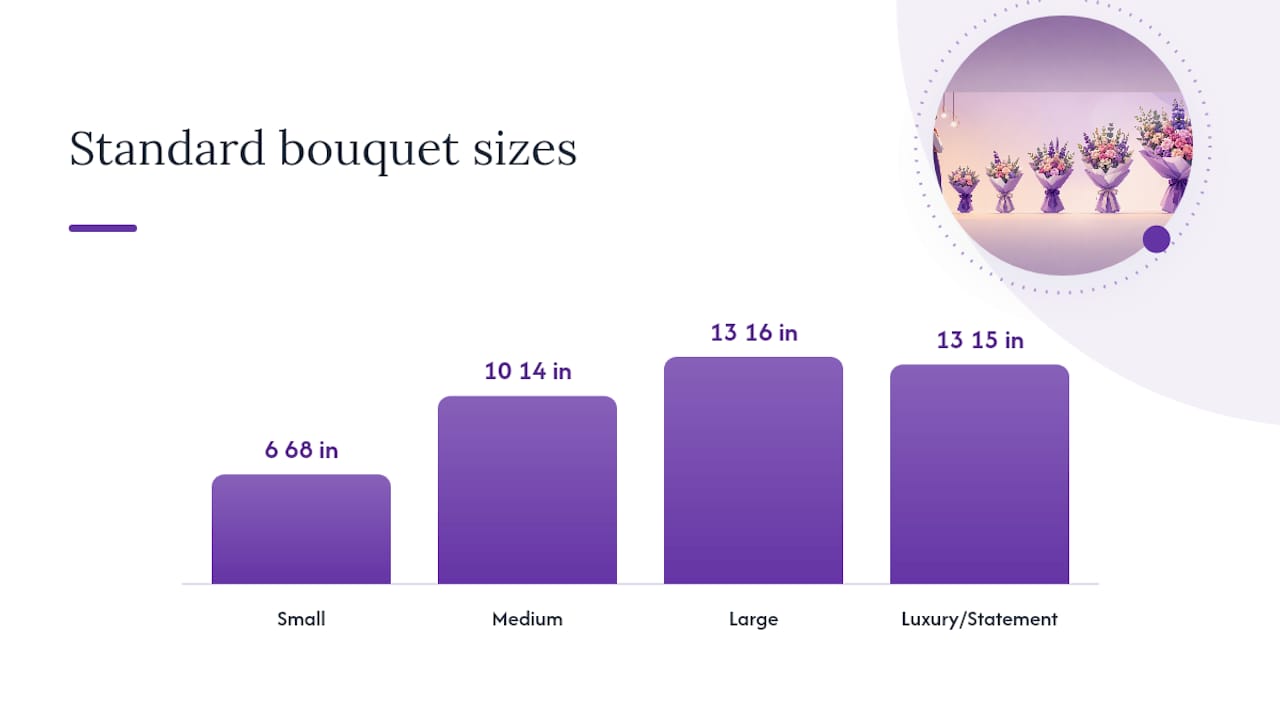
These ranges hold up as a rough industry consensus, but bloom head size throws the numbers around more than most buyers expect. A dozen dinner-plate dahlias or garden roses can visually fill the same space as 30 stems of ranunculus. Filler flowers like baby’s breath or wax flower are the opposite story. You need real volume of them to register at all, so a “small” bouquet built mostly from filler might actually require closer to 20 stems just to avoid looking sparse.
Pro Tip: If you are ordering online and unsure which category fits, ask what the focal bloom is before worrying about exact stem count. Five large peonies and 15 stems of sweet pea will land in completely different size categories despite similar totals.
A 25-rose bouquet is the example almost everyone asks about, and it typically lands right at the medium-to-large border, roughly 10 to 14 inches across depending on how tightly it’s wrapped. A loose, garden-style wrap reads larger than a tight, formal hand-tied wrap using the same 25 stems. Push that to 30 roses and you are solidly in large territory, usually 13 to 15 inches, dense enough to photograph as a clear focal point without looking overbuilt.
How Do You Choose the Right Bouquet Size for Your Situation?
Picking a size isn’t really about the flowers first. It’s about the person holding them, the dress they’re wearing, and the room they’ll stand in.
Start with these five factors before you place an order:
- Who is carrying it? A petite frame can get overwhelmed by a 16-inch luxury bouquet meant for a tall bride; scale down one size.
- What is the dress silhouette? Voluminous ball gowns and heavily embellished fabric generally pair with medium-to-large bouquets so the floral mass reads proportionate in photos, while sleek column gowns often look better with something smaller and more architectural.
- How will it photograph? Wide venue shots and outdoor ceremonies tend to swallow small bouquets on camera, so brides photographing against a big backdrop often size up.
- How large is the venue? A grand ballroom or cathedral calls for larger bouquets and centerpieces than an intimate backyard ceremony.
- What’s the budget? Every step up in size adds stems, and focal blooms cost more per stem than filler, so budget often decides between “medium with premium blooms” and “large with a filler-heavy build.”
Once you’ve answered those, translate the answer into a size adjustment rather than a vague feeling. Heavy fabric or a wide photo frame usually means sizing up by one category. A petite bride in a fitted gown usually means sizing down.
When you talk to your florist or fill out an order form, give them this: the stem count you’re targeting, one or two focal bloom examples you like, and how it will be carried (bouquet, hand-tied for a vase, or transported same-day to a venue). That single sentence does more to get you the right result than any amount of scrolling through inspiration photos.
Pro Tip: If your gown has a dramatic train or heavy beading, ask your florist to size up one bracket from what you’d instinctively pick from photos alone. Fabric volume competes with bouquet volume in every photo.
Why Do Florists Use the 3-5-8 Rule?
Most professional bouquets aren’t built stem by stem at random. They follow a proportion, and the most common one in the trade is the 3-5-8 rule: three focal flowers, five textural or greenery stems, and eight filler stems.
- A basic 3-5-8 build uses a ratio of three focal flowers, five textural stems, and eight filler stems, creating a balanced small-to-medium sized arrangement.
- Scaling this proportion up results in larger arrangements with more stems, suitable for bridal bouquets or centerpieces.
- Large focal blooms shift the math: three garden roses might do the visual work of five smaller focal flowers, so the ratio compresses rather than expands.
Height matters as much as stem count. A widely used proportional guideline for hand-tied bouquets and vase arrangements sets the tallest stem at roughly 1.5 to 1.6 times the vase height, which keeps an arrangement from looking top-heavy or squat. For a hand-carried bouquet, that same ratio translates to keeping your tallest stem about 1.5 times the length of your grip point below it.
How Do Focal, Textural, and Filler Stems Change the Look?
Every bouquet is built from three roles, and mixing up the ratio between them changes how “big” a bouquet reads even at the exact same stem count.
- Focal flowers carry the eye: peonies, garden roses, ranunculus, dahlias. Fewer stems needed per bouquet.
- Textural stems add movement and shape: eucalyptus, seeded greenery, spray roses.
- Filler stems add volume and softness: baby’s breath, wax flower, statice. You need more of these to register visually.
A 14-stem mid-size mix might run 3 focal, 4 textural, 7 filler. A 30-stem bridal mix scales that up to roughly 6 focal, 9 textural, 15 filler, still keeping focal blooms as the visual anchor rather than letting filler dominate.
Ask your florist about “head size” specifically, not just stem count. Two arrangements with 25 stems each can look nothing alike if one uses large dahlia heads and the other uses small spray mums. Grouping blooms in odd numbers, three, five, or eight, also reads more natural than symmetric even-number clusters, which is why professional arrangements rarely use round totals like 10 or 20 focal blooms.
Why Trust This Guide
Malikflowers builds handcrafted arrangements for delivery across Metro Vancouver, and every custom order, from a bridal bouquet to a same-day birthday gift, gets sized using the same stem-count and proportion logic covered above, backed by a satisfaction guarantee if the finished design misses the mark. In practice, a standard bridal bouquet typically runs medium-to-large (25 to 40 stems depending on focal bloom size), while a bridesmaid bouquet usually drops to small-to-medium (15 to 22 stems) to keep the visual hierarchy intact. This guide is written by Reza.
What Most Sizing Advice Gets Wrong
Most bouquet guides hand you a stem-count chart and stop there, as if 25 stems means the same thing regardless of what those stems are. It doesn’t. The chart matters less than the bloom you build it from, and treating stem count as the primary variable is where a lot of buyers end up disappointed with something that technically matches what they ordered.
The 3-5-8 rule gets undersold, too. People treat it as a formula for florists, not something a bride or gift-buyer can actually use when talking to a shop. But it’s the fastest way to describe what you want without knowing floral jargon: tell your florist you want it “focal-heavy” or “filler-heavy” and you’ve said more than any diameter measurement could.
If there’s one thing to prioritize first, it’s matching bouquet volume to how it will be seen, whether that’s held against a fitted gown, photographed across a wide venue, or handed over at someone’s front door. Stem count is the tool. Visual proportion is the goal.
If You Want Help Ordering a Correctly Sized Bouquet
Sizing a bouquet from a photo alone is guesswork, even with the chart above in hand. Malikflowers builds each order around a real conversation about focal blooms, stem count, and how the arrangement will be carried or displayed, backed by the same satisfaction guarantee that covers every custom design.
Brides get the most direct benefit here: a wedding bouquet consultation that accounts for your dress silhouette, venue scale, and bridal party size before a single stem gets cut, rather than a generic size picked off a menu. If you’re outside the wedding party and just need a properly proportioned gift, the same custom sizing applies across the catalog. Check availability for your date and request a consultation through the wedding page above to get your bouquet sized around your actual situation, not a guess.
Sources
FAQ
What Is the 3-5-8 Rule for Bouquets?
It’s a proportion florists use to balance an arrangement: 3 focal flowers, 5 textural stems, and 8 filler stems, scaled up or down depending on the size you need.
How Big Does a 25-Rose Bouquet Look?
A 25-rose bouquet typically lands between medium and large, roughly 10 to 14 inches across, with the exact size depending on rose head size and how tightly the wrap is tied.
What Is the 1.5x Vase Rule for Flowers?
A common proportional guideline sets the tallest stem at about 1.5 to 1.6 times the height of the vase, which keeps the arrangement visually balanced rather than top-heavy.
How Big Is a Bouquet of 30 Roses?
A 30-rose bouquet generally falls into the large category, around 13 to 15 inches in diameter, dense enough to serve as a bridal statement piece or a ceremony presentation bouquet.
Can Malikflowers Build a Custom-Sized Bouquet for My Wedding?
Yes. Malikflowers offers custom bridal consultations that size the bouquet around your dress, venue, and bridal party, backed by a satisfaction guarantee.